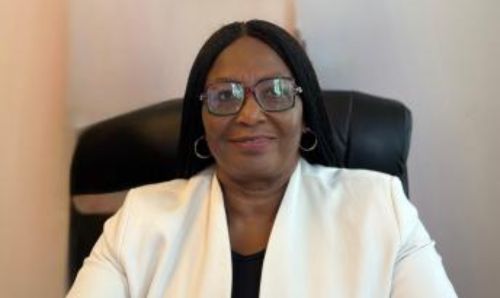
Dr Margaret M. Chebere
MSc Human Resources Development
Why did you choose the University of Manchester and what are your favourite things about the institution?
For context, I first studied at the University of Manchester in the 1997/98 academic year, pursuing an MSc in Human Resources Development. Several factors influenced my decision to study at the University. At the time, the course on Human Resources was not offered in any of the Universities in Ghana and The Institute for Development and Management (IDPM) during this time offered short courses in Human Resources which attracted some Ghanaians to acquire certificates to practice Human Resource Management/Development in Ghana. This caught my attention with my desire to pursue a programme in Human Resources.
Also, as a Ghanaian student, the United Kingdom was relatively close to home and there was no language barrier, which made the transition easier. The University had a strong reputation and credentials in Human Resources Management, which aligned perfectly with my academic and professional interests. I also knew several Ghanaians who had studied there and spoke highly of both the academic experience and the supportive learning environment. Looking back, I found Manchester to be intellectually stimulating, diverse, and welcoming, with a strong culture of academic excellence.
Why did you choose your course?
I have always been interested in understanding and managing people. My undergraduate studies (BA in Nursing with Psychology) were both centred on people and human behaviour, and they strengthened my desire to make a positive impact within the healthcare sector. Over time, I came to appreciate that while infrastructure, equipment, and funding are important, people remain the most critical resource in healthcare delivery. Pursuing a master’s degree in human resource development at the University of Manchester was therefore a natural progression.
As my career evolved, I became increasingly interested in the broader policy and institutional factors that shape development outcomes. This led me to pursue a PhD in Development Policy and Management again at the School of Environment and Education in the University of Manchester, which allowed me to deepen my understanding of how organisation s and governments can use policies to work to improve people's lives and advance sustainable development.
How has your career developed since leaving Manchester?
Without a doubt, my education at Manchester played an important role in shaping my professional journey. One of the highlights of my career was serving as Director of the Human Resources Development Division (HRDD) for the Ghana Health Service. In that role, I was responsible for the human resource management of one of the largest public sector workforces in Ghana, supporting the delivery of healthcare services across the country. It also enabled me to provide consultancy services to other countries under the World Health Organisation (WHO) and in-country with organisations such as World Bank and The Royal Tropical Institute in the Netherlands (KIT).
Today, I am privileged to serve as an Ambassador Extraordinary and Plenipotentiary of Ghana to the Kingdoms of Denmark and Sweden. Looking back, it has been a remarkable journey. If someone had predicted this path when I was a student in Manchester, I would have been just as surprised as anyone else.
What are the most significant challenges you’ve faced as a development practitioner, and how have you overcome them?
The greatest challenge has often been people. Individuals and institutions frequently have different priorities, motivations, and perspectives. I have learned that effective development work requires patience, empathy, and a genuine effort to understand where others are coming from. Building consensus is rarely easy, but it is often necessary. I have also relied heavily on faith and divine guidance throughout my career, particularly when faced with complex situations and difficult decisions.
Is your current role impacted by some of the world’s various crises (i.e., environmental, geopolitical, economic)? In what ways?
Yes, very much so. Climate change remains one of the defining challenges of our time, and Ghana, like many developing countries, faces important decisions regarding sustainable growth and environmental stewardship. I am constantly exploring ways to support Ghana's green transition and identify opportunities for collaboration with international partners.
Additionally, geopolitical developments increasingly shape the environment in which diplomacy, trade, and development cooperation take place. Conflicts, strategic competition among major powers, disruptions to global supply chains, and shifting international alliances all have direct implications for countries such as Ghana.
As Ambassador, I must constantly assess how these global dynamics affect Ghana's economic interests, food and energy security, investment climate, and broader foreign policy objectives. For example, tensions in the Middle East and the potential disruption or closure of the Strait of Hormuz can trigger sharp increases in global oil prices and freight costs. For an import-dependent country like Ghana, such developments can lead to higher fuel prices, increased transportation and production costs, and ultimately a higher cost of living. They can also affect the competitiveness of Ghanaian exports by increasing shipping costs and disrupting international supply chains.
The tenets of Ghana’s foreign policy are anchored on peace, dialogue, multilateralism, and mutually beneficial partnerships. As Ambassador, I work to ensure that, even amid global uncertainty, Ghana remains a trusted partner that is open for business, committed to international cooperation, and able to advance its national development priorities while contributing constructively to regional and global stability.
At the same time, sectors such as healthcare, education, and infrastructure continue to require significant investment. Serving in countries where many best practices have been developed provides an opportunity to facilitate knowledge exchange, partnerships, and investment that can help Ghana advance its development goals.
How is the development landscape changing, and what should current students know about this changing landscape?
One of the most significant changes is the way development assistance is being delivered. We are increasingly moving away from traditional models of direct aid and budgetary support towards strategic partnerships and collaborative development approaches. In many respects, this is a positive development because it encourages mutual accountability and shared value creation.
However, it is also important to recognize that historical inequalities persist, and there are circumstances where direct support remains necessary and beneficial. Current students should understand that development today is increasingly about partnership, innovation, co-creation and finding sustainable solutions that benefit all parties involved.
How has your qualification shaped your career? Did you feel prepared to enter the development sector after graduating?
Yes, absolutely. My qualifications have played a significant role in shaping my career. At a very basic level, earning a PhD demonstrates commitment, discipline, and expertise, qualities that are respected across professional environments.
More importantly, my academic training provided me with the analytical skills, research capabilities, and understanding of human and organisational development that have been invaluable throughout my career. I certainly felt prepared to enter the development sector after graduating. Within the health sector, which is itself a critical area of development, I rose to become one of the most senior officials in Ghana’s Health Service, while also providing consultancy and technical services to organisations such as the WHO, the World Bank and KIT.
What is your favourite memory of studying at Manchester?
One of my favourite memories of studying at Manchester was the warmth, support, and encouragement I received from the faculty and staff. I am especially grateful to Derek Eldridge, who was the Course Director for the MSc Human Resource Development programme and my supervisor during my master’s studies. His mentorship had such a profound impact on me that he became one of the main reasons I returned to Manchester to pursue my PhD. He subsequently served as my lead supervisor throughout my doctoral studies, alongside Richard Duncombe as my second supervisor.
Derek was not only a supervisor to me but a counsellor and a mentor and took interest in me and my family’s wellbeing. He was a supervisor extraordinaire. As a mother pursuing graduate studies away from home, I greatly appreciated the welcoming environment the University created. I particularly remember occasions when my children visited from Ghana. The kindness and genuine interest shown to them by faculty and staff left a lasting impression on me and reinforced the sense of community that existed beyond the classroom.
I also valued the University's culture of intellectual curiosity and freedom of thought. Students were encouraged to ask questions, challenge assumptions, and engage with diverse perspectives. For me, Manchester was not only a place of learning, but also a place where I felt respected, supported, and inspired to grow both academically and personally.
Do you have any advice for current/prospective students at the GDI?
Keep an open mind. Be curious and never stop asking questions. Take advantage of the diversity of perspectives around you and be willing to learn from people whose experiences differ from your own. Above all, treat everyone with respect.